
Étude
ESUMI
Evaluation de la suspicion de micro-éveils corticaux
Enhancing respiratory polygraphy with non‑cortical indicators: a pragmatic path toward more accurate OSA detection in primary care
Julien FAVIER *1, Ludovic ABUAF *2, Samuel WARBURTON *2,
*1 Somnidoc, Villerest, France ; *2 PSASS / Sleep Learning Center, Romorantin-Lanthenay, France
CONTEXT
Respiratory polygraphy (PG) is widely used in primary care to investigate suspected obstructive sleep apnea (OSA), particularly when access to polysomnography (PSG) is limited. However, RP may underestimate disease severity by failing to detect non-desaturating obstructive events associated with cortical micro-arousals, leading to discordance between respiratory indices and clinical symptoms.
OBJECTIVES
To develop additional criteria tailored to nocturnal respiratory polygraphy (NRP) in adults in order to improve the sensitivity of this examination, and to assess the possibility of suspecting a cortical micro-arousal related to an obstructive respiratory event not associated with desaturation during NRP through the visualization of non‑cortical indicators (NCI), and to determine whether integrating these non‑cortical physiological indicators into NRP interpretation improves detection of obstructive respiratory events associated with arousals and enhances agreement between enriched RP‑ and PSG‑derived respiratory indices in a primary care setting.
METHODS
We conducted a retrospective single-center observational study including seven adult ambulatory PSG recordings. Each recording underwent two independent analyses: standard PSG scoring according to American Academy of Sleep Medicine criteria, and an RP-based analysis simulating a primary care setting enriched with two additional obstructive event categories.
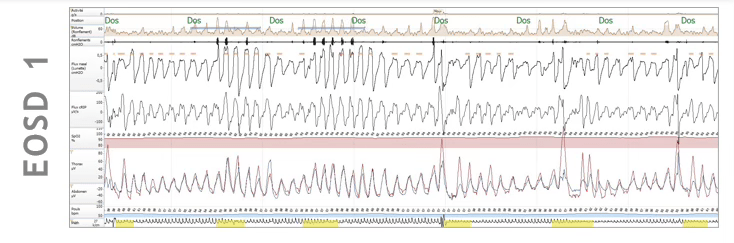
EOSD 1
(Obstructive Event Without Desaturation)
to mark an event of the obstructive hypopnea type, without desaturation, but associated with suspected arousal.
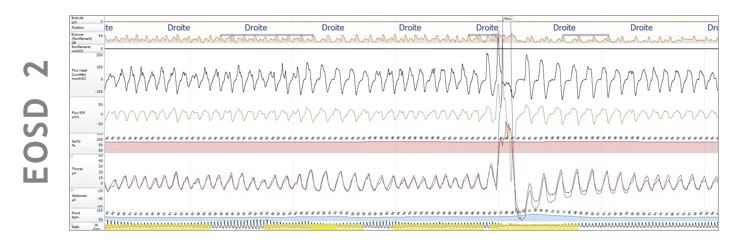
EOSD 2
to mark an event of the RERA type (Respiratory Effort-Related Arousal) associated with suspected micro-arousal.
CNIL MR004 declaration filed
An arousal related to an obstructive respiratory event is suspected, on ventilatory polygraphy, if at least 3 INCs are present among the following:
STATISTICAL ANALYSIS
Agreement between enriched RP and PSG was assessed at the event level and index level. Event-level diagnostic performance was evaluated using sensitivity and positive predictive value (PPV) with exact 95% confidence intervals (Clopper–Pearson). True negatives were not defined due to the event-based design; therefore, specificity and negative predictive value were not calculated. Index-level agreement was assessed using:
intraclass correlation coefficient (ICC) for absolute agreement (two-way mixed-effects, single measures), Bland–Altman analysis, Pearson and Spearman correlation coefficients. ICC confidence intervals were estimated using bootstrap resampling (10,000 iterations). Bland–Altman analyses were performed on raw indices and ratios when appropriate
RESULTS
Enriched PG identified 1,064 PSG-confirmed respiratory arousals, with an overall PPV of 91.1% (95% CI 89.3–92.7) and a sensitivity of 91.5% (95% CI 89.8–93.0).
EOSD type 2 showed the highest predictive performance (PPV 93.6%, 95% CI 91.5–95.3). Agreement between RP-derived and PSG-derived indices was excellent, with ICC values of 0.982 for EOSD 1 versus non-desaturating hypopneas and 0.987 for EOSD 2 versus respiratory effort–related micro-arousals. Bland–Altman analyses showed minimal bias and narrow limits of agreement.
DIAGNOSTIC PERFORMANCE OF ENRICHED RESPIRATORY POLYGRAPHY
Event-level analysis compared to polysomnography (reference standard)
| INDICATOR | ESTIMATE | 95% CONFIDENCE INTERNAL |
|---|---|---|
| Overall EOSD positive predictive value (PPV) |
91,1% | 89,3 – 92,7% |
| EOSD type 2 positive predictive value (PPV) |
93,6% | 91,5 – 95,3% |
| EOSD type 1 positive predictive value (PPV) |
87,5% | 84,2 – 90,3% |
| Overall EOSD sensitivity | 91,5% | 89,8 – 93,0% |
| Event-level false positive rate (1 – PPV) |
8,9% | 7,3 – 10,7% |
| Duration of analysis | 2876,6 Min |
| Number of arousals | 1942 |
| Mean arousals index | 40,09/h |
| Number of non-desaturating hypopnea | 1152 |
| Mean index of non-desaturating hypopnea | 23,42/h |
| Number of EOSD | 1168 |
| Mean of EOSD index | 23,7/h |
| Number of EOSD relative to RERA or non-desaturating hypopnea | 1076 |
CONCLUSION
Enriched respiratory polygraphy provides reliable and clinically meaningful estimates of obstructive respiratory event burden. This pragmatic approach supports more accurate OSA assessment in primary care, particularly in isolated settings where polysomnography is not accessible.
Conflicts of interest: Ludovic Abuaf is the president of the company PSASS / SLC. Dr Julien Favier is a member of the scientific board of SLC.